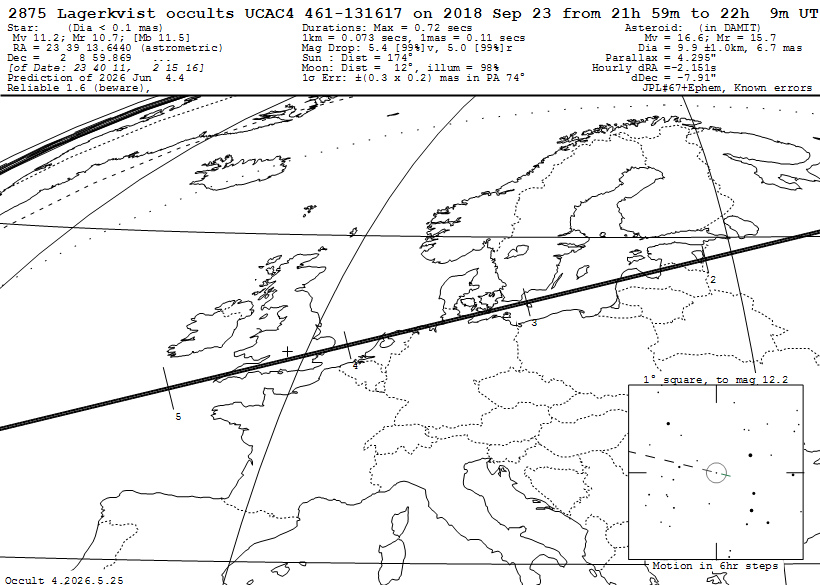
1. Summary: A double star, and a binary asteroid ? On 2018 Sept 23, a routine asteroid occultation prediction (see Note-1) was monitored by two UK observers: Tim Haymes (Maidenhead) and Peter Tickner (Reading). The asteroid (2875) Lagerkvist (diameter 10km) was predicted to occult UCAC4 461-131617 (v 11.2) at 0204 UT with only a few seconds uncertainty in mid time. Since the asteroid was magnitude 16, a total extinction of the 11th magnitude star was expected. The result is reported on Euraster.net archive. A partial occultation was recorded by both observers with an unexplained time difference. The time difference is discussed, and a binary asteroid proposed. Comments invited via the user group: UKoccultations.group.io 2. Predictions The observer's back garden telescopes were separated by 11 km along the direction of motion and by about 5 km in the north-south direction. In Fig-1 the predicted path was between the blue lines. The red line being the northern limit (1-sigma) of uncertainty. Fig-2 is the Occult4 prediction in 2018, while Fig-3 is is a post-diction with the currently known errors. (More accurate than Fig-2). An X marks the observer's positions. The post-diction indicates the observers were within the shadow path. Fig-1 Location of the observed chords............................Fig-2 Prediction in 2018 (prior to orbital updates)........Fig-3 .Occult4 post-diction with JPL#67+ephem
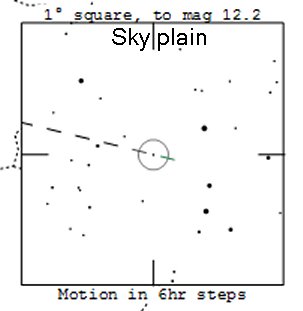
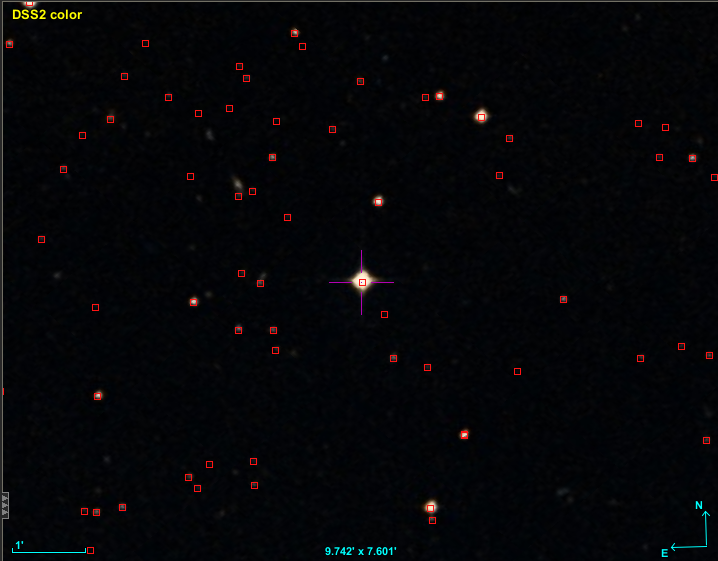
3. Star ID Field in C2A Planetarium software by Astrosurf (UCAC4 catalogue)
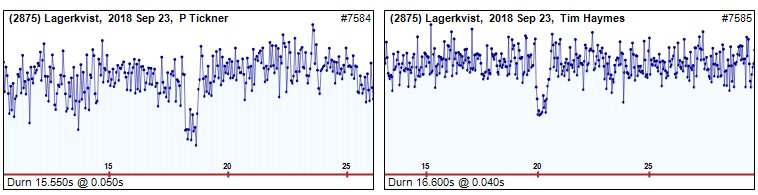
4. Observations: The observers recorded one chord each, of similar magnitue drop of approximatlt 0.4 or 0.5 magnitude. T. Haymes (Maidenhead): The observation was unusal. (Fig-6) There was roughly a 40% flux drop of duration 0.6s +/- 0.1s (15 frames), or about 0.5 magnitudes and no disappearance. The event mid-time was 2204h 20.2s UT Location: W 00 48 58.2, N 51 30 23.8, MSL +75m... D 22:04:19.86 (+/-
0.04 s), R 22:04:20.46 (+/- 0.06 s). MID
TIME 2204 20.2s Euraster Report
<here> P. Tickner (Reading) : Reported a dip in his light curve at lower S/n (Fig-5) owing to dew formation on the SCT corrector plate. The light drop was not seen initially but on closer inspection a drop of similar duration (0.55s) was identified, and interestingly was at a mid time of 2204hr 18.5s UT, which was 1.7 sec earlier than Haymes. For a single object the time difference should have been later. Location: W 00 55 14.5, N 51 25 33.8, MSL+44m.... D 22:04:18.21
(+/- 0.04 s), R 22:04:18.76 (+/-0.06 s). MID
TIME 2204 18.5s Euraster Report
<here> Fig-4 Video Camera frame 0.3 degrees (Haymes), ......Fig-5 Light curve by Tickner, and ..............Fig-6 from Haymes indicating an approximate 55% and 45% drop respectively.
Table
One: Recording systems T Haymes
.30cm F/4... WAT910HX at 25 fps..
Blackbox GPSBOXSPRITE OccuRec/Tangra/AOTA...
AVI
5.
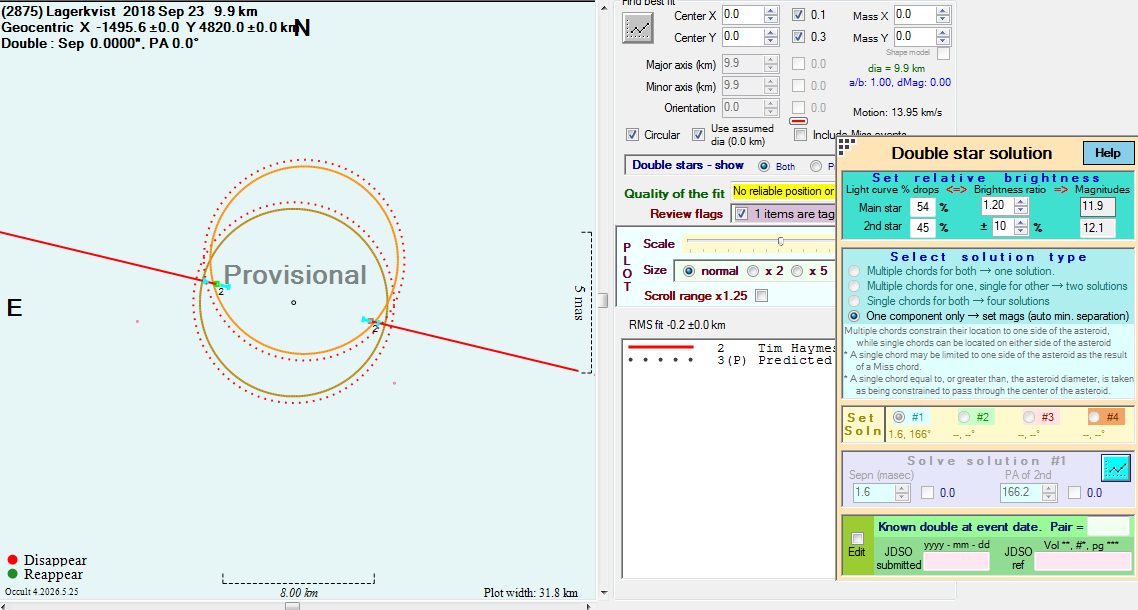
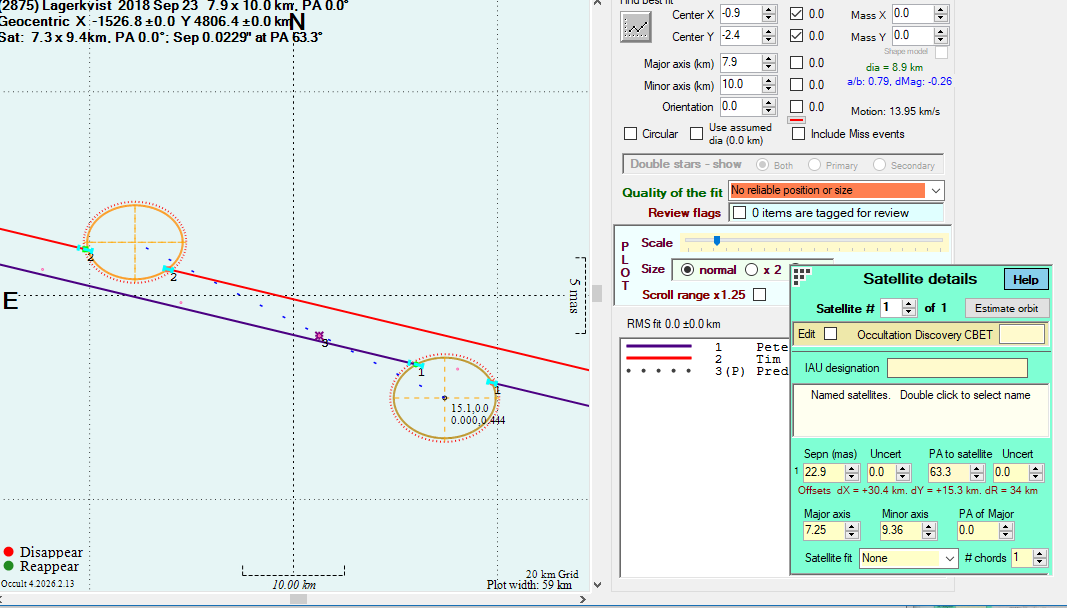
Analysis It was suggested (discussion on PLANOCCULT forum) that the asteroid occulted a minor component of the star and this was a double-star "discovery". When reporting this to the forum, several observers remarked that step events had been recorded for double stars in the past (example). The Gaia catalogue indicated a less than ideal position for UCAC4 461-131617 (ruwe 1.60). This suggests a likely hood of an unresolved multiple system. So the observed step event is caused by some multiplicity, the asteroid having occulted a companion star. The component separation is not resolved in Gaia DR3 and is estimated to be less than 0.1" arc based on the spatial resolution of Gaia. The observation chord by Haymes was used in Occult4 to deduce the minimum separation and position angle (Fig-7). (The same result is presumed from the Tickner chord).
Fig-7 Solution for one component only: Minimum Separation 0.0016"arc, in PA 166. Magnitudes A,B = 11.9, 12,1. The B component being occulted.
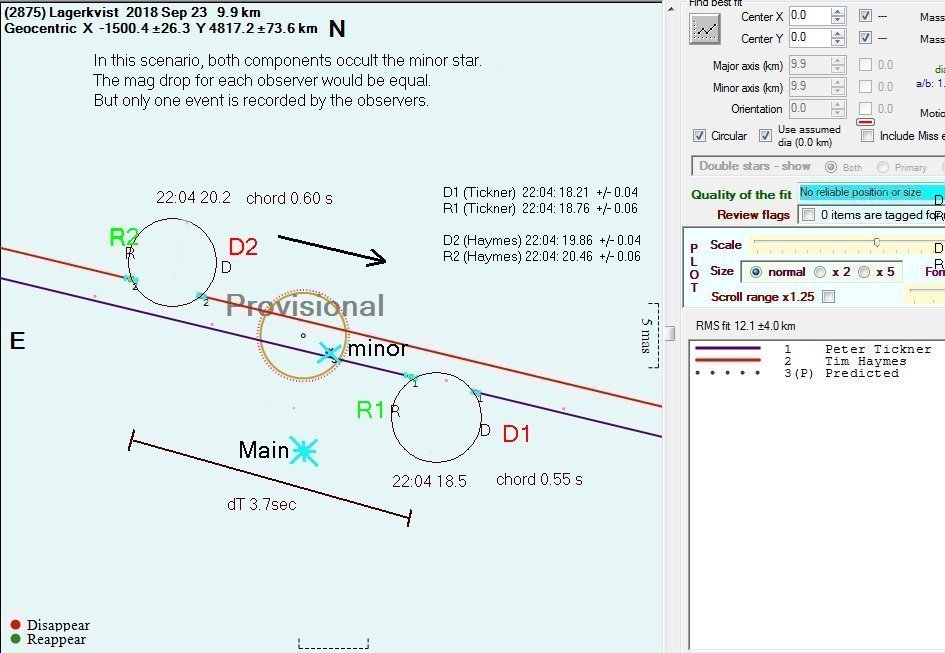
5.2) Apparent Time difference A difference in mid time of the two observers is not fully explained. With the shadow direction from East to West (Fig-8), a difference of a few seconds is expected, with Haymes seeing the event first. But Tickner observed the first contact (Tickner mid-time D 22:04:18.21, Haymes D 22:04:19.86)
The event order of D-R chords appeares (at first) to be reversed. This could be explained by a error in one of the observers GPS clocks. This we suggest is unlikly given the accuracy of these GPS systems. To bring the chords into alignment a time adjustment to Ticker of +4.4sec is required. i.e. his GPS clock was behind UT (slow) (Or similarly a negative correction for Haymes). One possible source of time error is in P.Tickner's set up which uses
a GPS-USB time source (AiryLab"TimeBox") and USB3 camera.
While this has been tested at 100 fps with good results, there is an
OS system delay in W7. This was measured and taken
into account. It does not explain
the large difference in our observations of these occultation chords. If the time offset is NOT caused by an absolute timing error, then some physical reason with the asteroid is suggested, perhaps a double system or very unusual shape.
5.3)
The observed mid-time difference represents about 3 asteroid diameters.
Binary? 5.4) Occult Analysis for a proposed Binary asteroid: Here, the alignment in Occult has a hypothetical chord representing a "no occultation zone", where the two bodies could pass without an obvious detection. But for us, we each observed a single chord caused by occultation of one stellar component. The other stellar component would be somewhere else near-by and not occulted.
5)
Conclusion: Further observations of (2875) Largerkvist are sought.
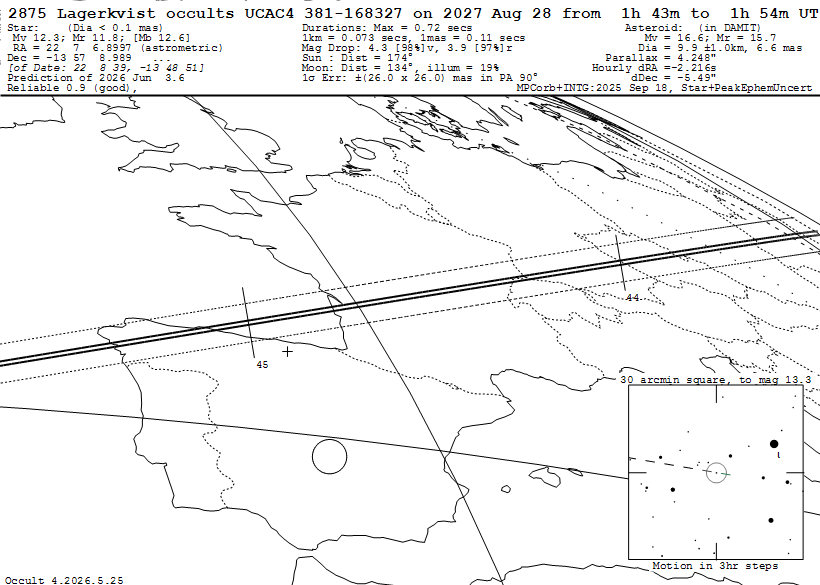
Next favourable European event:
6) Appendix The Occult Watcher display of observations for (2875) on 2018 Sept 23: . The green ticks are the positive chords
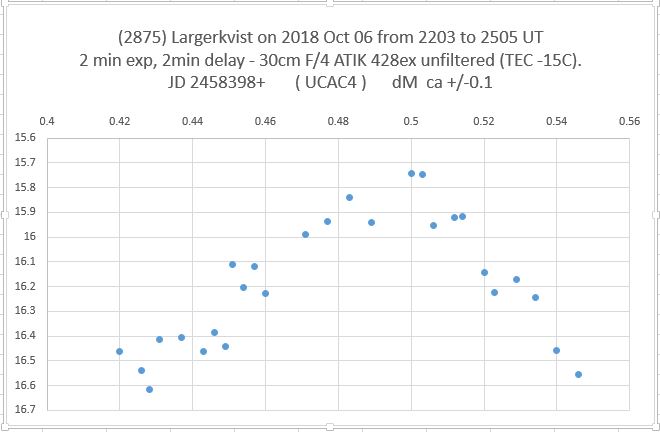
Published rotaional light curve for Largerkvist (See Note-2)
Measured by Tim Haymes: Period is 3 hrs ( probably half period ) with 0.7 magnitude amplitude.
Note-1: Prediction provided by John Talbot, Abingdon, UK using Occult
4 software. Details from the UKOCL
feed to OccultWatcher application.
Tim Haymes Is a member of the British Astronomical Association
(BAA), and the International
Occultation Timing Association (IOTA-ES) Based in the S and SW England, he uses a GPS time inserted
video camera (QHY174mGPS) on a Schmdt-Cassegrain telescope. See his observation
page 2010 to present |
%20Path%20Map.JPG)
_Occult4_2018.JPG)
_Frame.JPG)
%20OW%20strip.JPG)
%20Rotation%205.6hr.JPG)
_C2A.JPG)