(468861)2013
LU28 occults TYC 2449-01891-1
2025-Jan-30, 0150-0152 UT
~ high priority event ~
Created: 2025
Jan 05
Prediction upadate Jan 22
This unusual trans-neptunian with a retrograde orbit, has a semi-major axis of 183 AU. Very little is known about its size or shape. There have been no successfully observed occultations, so its orbit is also less well defined. Observations are urgently required.
Observations are requested by the BAA Asteroid and Remote Planets Section (ARPS). Successful observations will be collected by the BAA, and passed onto the Paris Observatory Teams (Lucky Star project) through the Occult-Portal reporting arrangement. We ask for video recordings of the mag r11.5, star. Details follow...
LU28
is being studied by the ERC Lucky Star (Paris Observatory). A detailed
overview of upcoming stellar predictions is presented by Dr. Damya Souami
Ph.D in Celestial Mechanics (Researcher at LESIA/Observatoire de Paris)
in the current issue of: Journal for Occultation Astronomy
(JOA) https://iota-es.de/JOA/JOA2025_1.pdf
There
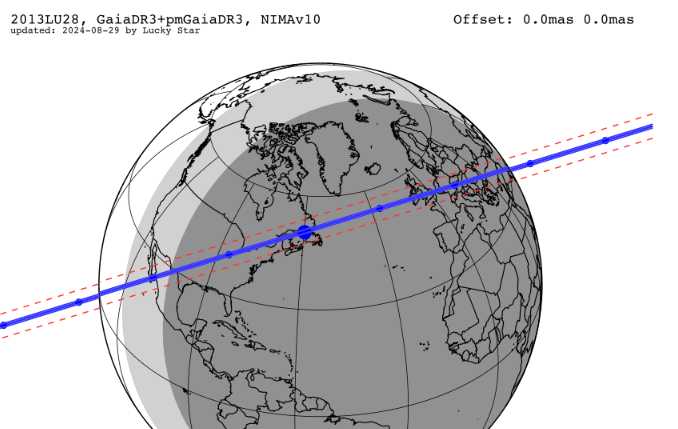
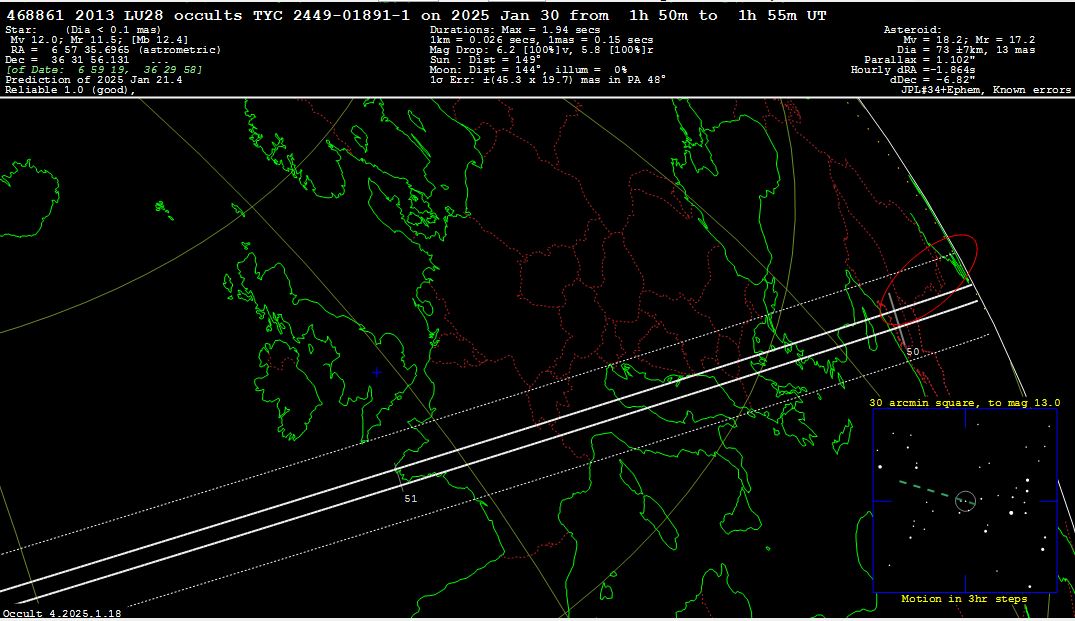
are two predictions for the shadow path separated by about 400 km.
(1) The Lucky Star prediction puts the shadow over southern UK https://lesia.obspm.fr/lucky-star/occ.php?p=142891
(2) The JPL Horizons orbit puts the shadow further south over France
and Southern Europe
https://cloud.occultwatcher.net/event/1490-468861-98798-650293-T01891-1
Observers who are distributed over a wide area have a better chance of detecting the TNO when the star is occulted. More observations are welcomed. Some observers may be effected by localised cloud, others may not. NEGATIVE detections are important.
The ERC Lucky
Star prediction passes over the UK, HENCE the greater interest from
the UK perspective. Note the path width uncertainty is +/- 100 miles.
Observers located inside the red dotted lines
have the best chance of success.
Shadow path: Prediction from Lucky Star (dated 2024-08-29), and the JPL Horizons path on the right, plotted by Occult software.
Star:
TYC 2449-01891-1
Magnitude: v 12.0, r 11.5
RA/Dec: 06 57 35 +36 31 35 (J2000)
Alt/Az: 51/267 in Auriga.
When and how long:
Predicted mid occultation time: 01:51: 00 UT
Observe/record from 0149
to 0153UT
Error time: +/- 15sec
Maximum occultation duration:
2.0 seconds
Moon-light: None
Equipment:
Telescope Apertures >= 8"
Camera: mono CMOS, or colour imagers with larger apertures.
Frame rate: 5 fps or faster. 10fps preferred. (Depends on aperture,
camera, transparency.)
Timing:
Timing of the image frames is important to derive a mid time.
Even without timing a duration can be measured.
Please insure the system clock has been synced to a network time or
GPS signal before observing, and keep any UT log files.
Negative observations are important (i.e. no occultation recorded). Please report these.
Recording:
Any that will add the system time (UT) to the images. Examples are:
Sharpcap and Firecapture.
File
format:
FITS and SER (CMOS), AVI (8bit), Drift scan may be possible, and drift
through ( Dob undriven ).
Report:
Please send a preliminary report (success or failure) to tvh.observatory@btinternet.com,
Assistant Director,
BAA Asteroids and
Remote Planets Section.
Your
name / astro group
E-mail:
Location:
Summary:
Recording:
Positive or Negative
Timings (if any)
About occultations and this page:
This is a personal web page to support occultation observers. There
is a discussion group: https://groups.io/g/UKoccultations
which observers are welcome to join.
An observation sent to the writer or the BAA will be acknowledged.